
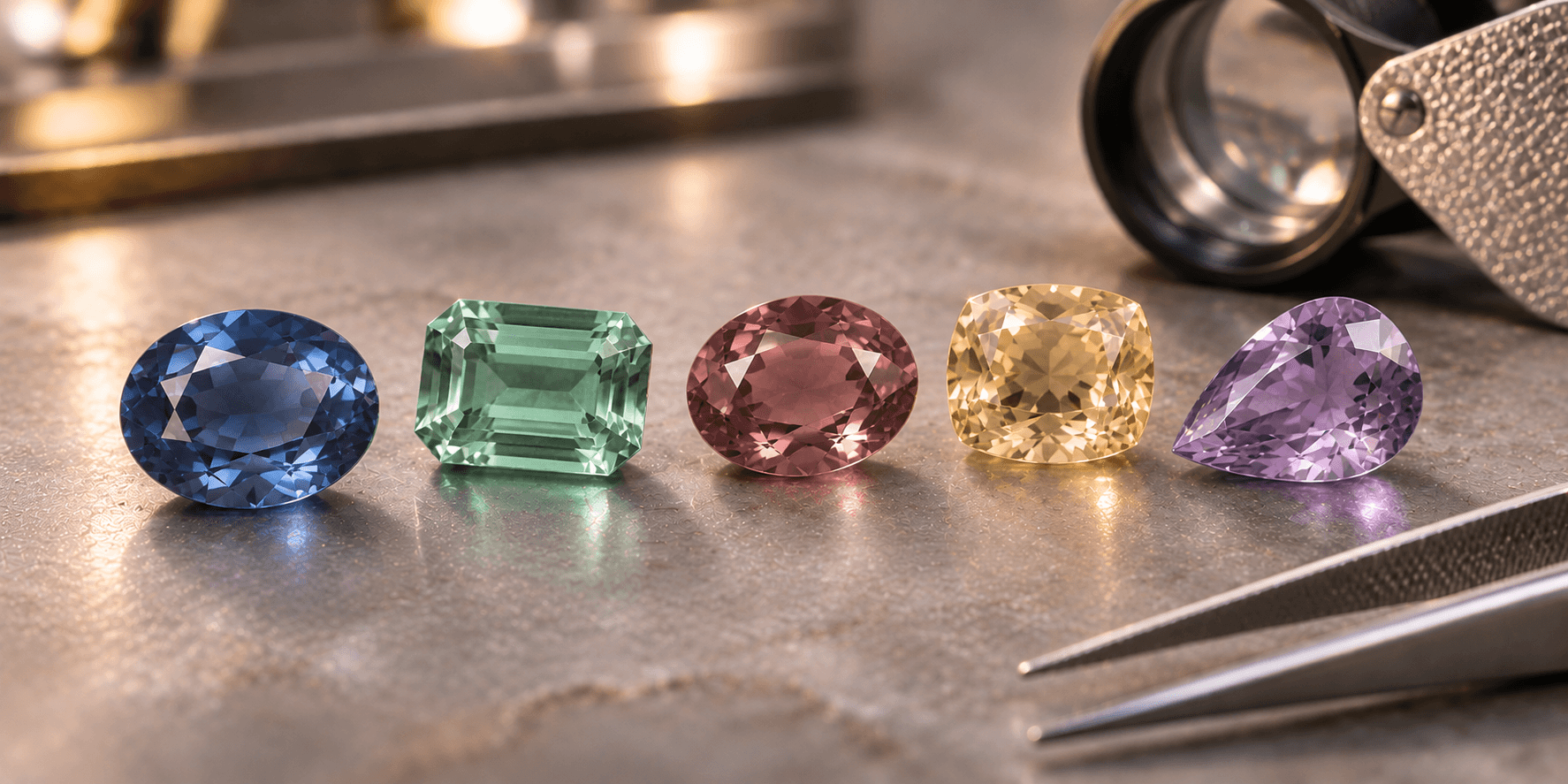
Colored Gemstones
The Rarest Colors
on Earth
We source exceptional sapphires, rubies, emeralds, and rare collector stones from the world's premier origins — each selected for superior color, clarity, and character.
Online, we show only a small part of our collection. We hold a wide array of precious and semi-precious gemstones in a broad range of colors, sizes and qualities, and we cut and polish many of them ourselves. Start a consultation to see the full selection in person or over video.
Start a ConsultationGemstone Guide
The 18 Most Loved Colored Gemstones
What makes each one special, and what to know before you wear it.
Precious
Sapphire
The blue variety of corundum and, after diamond, the hardest gem used in jewelry. Sapphire also comes in nearly every other color, including the rare pink-orange padparadscha.
- Colors
- Blue, pink, yellow, padparadscha, white
- Hardness
- 9 on the Mohs scale
- Birthstone
- September
Hard and tough enough for an engagement ring worn every day.
Browse Sapphire →Precious
Ruby
Red corundum, sapphire's sister stone. Fine, large rubies are among the most valuable gems in the world, with color the deciding factor.
- Colors
- Red, from pinkish to deep "pigeon blood"
- Hardness
- 9 on the Mohs scale
- Birthstone
- July
As durable as sapphire; most rubies are heated to improve their color, which is accepted and permanent.
Browse Ruby →Precious
Emerald
The green variety of beryl. Its natural inclusions, called the jardin ("garden"), are expected and part of its character. Colombia, Zambia and Brazil are the classic sources.
- Colors
- Bluish green to pure, vivid green
- Hardness
- 7.5–8 on the Mohs scale
- Birthstone
- May
Most emeralds are oiled to improve clarity. Keep them away from ultrasonic cleaners and heat.
Browse Emerald →Semi-precious
Tanzanite
Found in only one place on earth, a few square miles near Mount Kilimanjaro. Tanzanite shows blue, violet and burgundy as it is turned in the light.
- Colors
- Violet-blue to blue-violet
- Hardness
- 6–6.5 on the Mohs scale
- Birthstone
- December
Softer than it looks: ideal for earrings and pendants, or a ring with a protective setting.
Browse Tanzanite →Semi-precious
Aquamarine
Emerald's sea-blue cousin in the beryl family. Aquamarine is usually very clean, so it is often cut in large, open shapes that show off its clarity.
- Colors
- Pale sky blue to deep Santa Maria blue
- Hardness
- 7.5–8 on the Mohs scale
- Birthstone
- March
Durable for everyday wear; deeper blue is the most valued.
Ask to see aquamarine →Semi-precious
Morganite
Pink-to-peach beryl, named after the financier J.P. Morgan. Its warm color pairs especially well with rose gold.
- Colors
- Peach to soft pink
- Hardness
- 7.5–8 on the Mohs scale
- Birthstone
- —
A popular, affordable engagement stone; a halo or bezel adds protection.
Browse Morganite →Semi-precious
Tourmaline
Tourmaline has the widest color range of any gem. A single crystal can hold two or three colors, and copper-bearing Paraíba tourmaline glows an electric blue-green.
- Colors
- Every color, including bi-color "watermelon" and neon Paraíba blue
- Hardness
- 7–7.5 on the Mohs scale
- Birthstone
- October
Good for most jewelry; Paraíba stones are rare and priced accordingly.
Ask to see tourmaline →Semi-precious
Peridot
One of the few gems that comes in only one color. Peridot forms deep in the earth's mantle and has even been found in meteorites.
- Colors
- Yellowish green to olive green
- Hardness
- 6.5–7 on the Mohs scale
- Birthstone
- August
Best in earrings, pendants and occasional-wear rings; avoid sudden temperature changes.
Ask to see peridot →Semi-precious
Garnet
Garnet is a family of gems rather than one stone. Most people know the classic wine red, but rare green tsavorite and fiery demantoid are prized by collectors.
- Colors
- Deep red, plus green tsavorite and demantoid, and orange spessartite
- Hardness
- 6.5–7.5 on the Mohs scale
- Birthstone
- January
Generally durable; a great value for rich, saturated color.
Ask to see garnet →Semi-precious
Amethyst
The purple variety of quartz, once valued as highly as ruby and sapphire. Fine amethyst is available in large sizes at approachable prices.
- Colors
- Lilac to deep royal purple
- Hardness
- 7 on the Mohs scale
- Birthstone
- February
Can fade with long exposure to strong sunlight; otherwise easy to wear.
Ask to see amethyst →Semi-precious
Citrine
The golden variety of quartz, with a warm, sunny color that suits yellow gold. Large, clean citrines are plentiful and affordable.
- Colors
- Pale lemon to deep Madeira orange
- Hardness
- 7 on the Mohs scale
- Birthstone
- November
Durable enough for everyday wear.
Ask to see citrine →Semi-precious
Topaz
Best known in shades of blue, though the rare golden-orange "imperial" topaz from Brazil is the most prized. Topaz is hard and very brilliant.
- Colors
- Blue, golden imperial, pink, colorless
- Hardness
- 8 on the Mohs scale
- Birthstone
- November
Hard, but can split with a sharp knock; a protective setting is wise for rings.
Ask to see topaz →Semi-precious
Opal
Opal's "play of color" comes from microscopic spheres of silica that split light into rainbow flashes. Australia and Ethiopia are the main sources.
- Colors
- White, black, crystal and fire opal with flashes of every color
- Hardness
- 5.5–6.5 on the Mohs scale
- Birthstone
- October
Opal contains water: protect it from heat, knocks and sudden temperature changes.
Ask to see opal →Organic gem
Pearl
The only gem grown by a living creature. Akoya, South Sea, Tahitian and freshwater pearls each have their own size, color and luster.
- Colors
- White, cream, pink, golden, black
- Hardness
- 2.5–4.5 on the Mohs scale
- Birthstone
- June
Last on, first off: put pearls on after perfume and hairspray, and wipe them after wearing.
Ask to see pearl →Semi-precious
Spinel
For centuries spinel was mistaken for ruby; several famous "rubies" in royal crowns are spinels. Today it is loved for bright, untreated color.
- Colors
- Red, hot pink, cobalt blue, lavender, gray
- Hardness
- 8 on the Mohs scale
- Birthstone
- August
Hard and tough, and rarely treated, which makes it a connoisseur's choice.
Browse Spinel →Semi-precious
Alexandrite
A rare variety of chrysoberyl famous for its color change. Discovered in Russia's Ural Mountains in the 1830s, fine alexandrite is one of the most valuable colored gems.
- Colors
- Green to bluish green in daylight, red to purplish red in lamplight
- Hardness
- 8.5 on the Mohs scale
- Birthstone
- June
Hard and tough enough for everyday wear; the stronger the color change, the more valuable the stone.
Browse Alexandrite →Semi-precious
Moonstone
A feldspar known for adularescence, a soft light that seems to glide across the stone as it moves. The finest show a bright blue sheen on a clear body; Sri Lanka and India are classic sources.
- Colors
- Colorless, white, peach, gray and rainbow, with a floating blue or white glow
- Hardness
- 6–6.5 on the Mohs scale
- Birthstone
- June
Best in pendants, earrings and protected ring settings; avoid hard knocks.
Ask to see moonstone →Semi-precious
Turquoise
One of the oldest gems in history, prized from ancient Egypt to the American Southwest. Even, intense "robin's egg" blue is the most valued color.
- Colors
- Sky blue to blue-green, often with a fine matrix of veins
- Hardness
- 5–6 on the Mohs scale
- Birthstone
- December
Turquoise is porous: keep it away from oils, lotions and cleaning products, and wipe it with a soft cloth.
Ask to see turquoise →Responsible Sourcing
Traceable from Origin
We cut and polish our own precious and semi-precious gemstones, and maintain direct relationships with trusted dealers and cutters across major gem origins — Kashmir, Burma, Colombia, Ceylon, and Tanzania. Every stone we carry is traceable, ethically sourced, and accompanied by documentation from recognized gemological laboratories including GIA, GRS, and Gübelin.
Private Gem Viewings Available
We regularly receive exceptional stones in our studio. Book a private viewing to see our current selection in person.
Book a Viewing